Sunday, August 11, 2013

No need for a history lesson here

Maybe a geologist would disagree with me, would tell me that the formation of the Alps is a long and remarkable story, fit for lulling children to sleep at bedtime or creating an HBO series, but my lab group and I did not visit the Alps because of its history. We went to find some snow that we could still throw at each other in August 


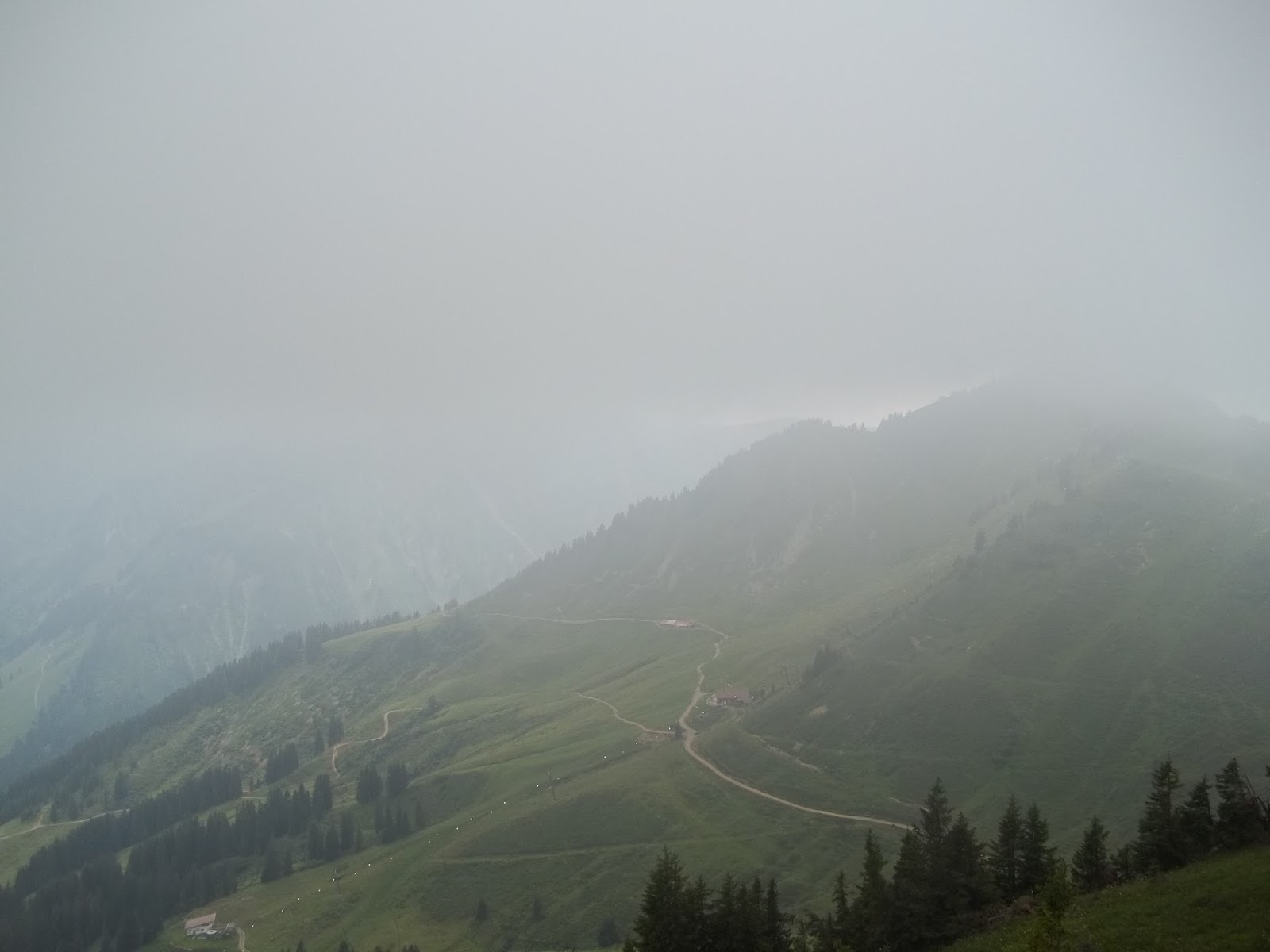
to lose ourselves in clouds even while our feet were on the ground


to test our determination on the craggy sides of cliff faces


to listen to the wind chimes that echoed throughout the valleys of the alps, which rang even when there was no wind and turned out to be cowbells (but really they sounded just like a huge collection of wind chimes),


and to admire the view, of course.


It’s hard to describe what it felt like to be at the top of one of those mountains. I know I’m not the first IRES participant to chronicle an experience at the Alps this summer, but I think one thing you guys left out is the exhaustion you feel by the time you get to the top. Still, it wasn’t the exhaustion that made you want to stay up at the summit for the rest of the day, or the thought of a long hike back down. Sitting on top of the world, breathing clean mountain air as the wind ruffled the tall grass and flowers all around, scanning the miles and miles you could see in every direction without a single sign of human development, is just a cool experience. Every once in a while on our journeys, we would come across an old hidden cabin that served refreshments to hikers. I tried some buttermilk, a specialty of the region, as well as a drink known as Holunderblütenschorle, which contains syrup made from a local type of flower (The Holunder was so good that I actually bought some of the syrup at a grocery store later, and I’ve been adding it to water to make a really tasty drink. We need this stuff in America). We came across a lake one day and went swimming for a while, maybe getting a little too much sun while we were at it.

Of course, there was an educational aspect. As a lab, we actually stayed at a big lodge in the area that the University of Marburg owns, and so the trip was on their dime (one of the best things about the trip). In the evenings, we had enough talks from different members of the lab group that almost everyone presented something. I picked up some information on new methods in biochemistry. I even gave a presentation about the research that I had been doing at Emory for the past semester. The feedback was pretty good. I got a lot of questions and I think my lab mates learned something interesting about c-di-GMP signaling. We did have to keep the talks short, since most people had cracked open a beer or two by the time we started seminars in the evening.

Just look at this beautiful lab group


I’m going to miss these guys when I leave Marburg in about a week! Then I’ve got just a bit of traveling before classes start back up at Emory. I’m immensely grateful that I got this trip to the Alps in this summer. More than any other trip I’ve taken this summer, it really just felt like a vacation. I stayed in a lodge with a big group of people I knew for a few days, and never had to worry about a thing. I didn’t need a tour guide. I didn’t have to read any plaques or explanations to appreciate the scenery around me. I just had to be there.

And when we started a bonfire, and I showed my lab mates how roast marshmallows from the huge bag I had brought from the U.S., that was one of the most fun nights I’ve had all summer.


Tuesday, August 6, 2013

From Division to 1UP


The tram station had to be crowded, or the plan would fall apart. That made 5:26 on a Tuesday perfect. Unsuspecting middle-class Germans packed the line next to the tracks, near enough that nobody would dare step in front of them and so that they could be that much closer to the briefly available doors, which were just coming into view around the bend. They stared at the approaching train to avoid making eye contact with the flushed, plump businessmen around them, the lady holding a cane who had some kind of wart on her forehead, the mustachioed man asking for money. All they wanted was home, and taking off their shoes. Unfortunately for them, the monkey wrench to their plans and routines was riding to meet them, a college newbie out to prove his loyalty to the 1up crew of Berlin. He wore H&M jeans with a beanie and thick black-framed glasses, indistinguishable from hundreds of other students in the city, but his laptop case was one laptop short of utilized.

As the tram rolled to a stop and the doors opened to a rush of people, Mr. Monkey Wrench stood up, smiled, and yanked on a bright red emergency brake. In three minutes, three things would happen. The authorities would arrive, the train would be cleared for departure, and a band of miscreants that had just given the tram a new paint job would have disappeared as if through trap doors in a magic show.

From purses, from backpacks, hoodie pockets, and baggy sleeves suddenly appeared canisters of spray paint. One woman in a black skirt and business jacket slipped a surgeon’s mask over her face and made the train her canvas. To her left, a red-faced man with a balding head held a canister in each hand. With white he laid the background, overlaying it with bright red lettering. Another was intent on depicting a hand reaching up from underneath the train. Twelve of the crowd around the train were no longer waiting for a ride back to their homes, but illegally transforming one of the state’s prized devices into what they considered a work of art.

Paint fumes repelled the commuters as if as the crew was spraying bug spray on a swarm of insects. Some stared in indignation, others in fascination, but almost all stared as chalky grey paint began to disappear beneath flashy tags and hasty murals. Gangs and artists at work are two things people are wary of messing with, and the spectacle in front of them seemed to be some strange combination of both. A boy in a Chicago Bulls hat whipped out a smart phone and started taking a video, a smile on his face, as another couple others hurried away to find some blue-vested official. Their intention would not make a difference.

When the authorities arrived on schedule, all they found was the message left for them and everyone else in the city, emblazoned from top to bottom and door to door like a bold billboard on wheels:

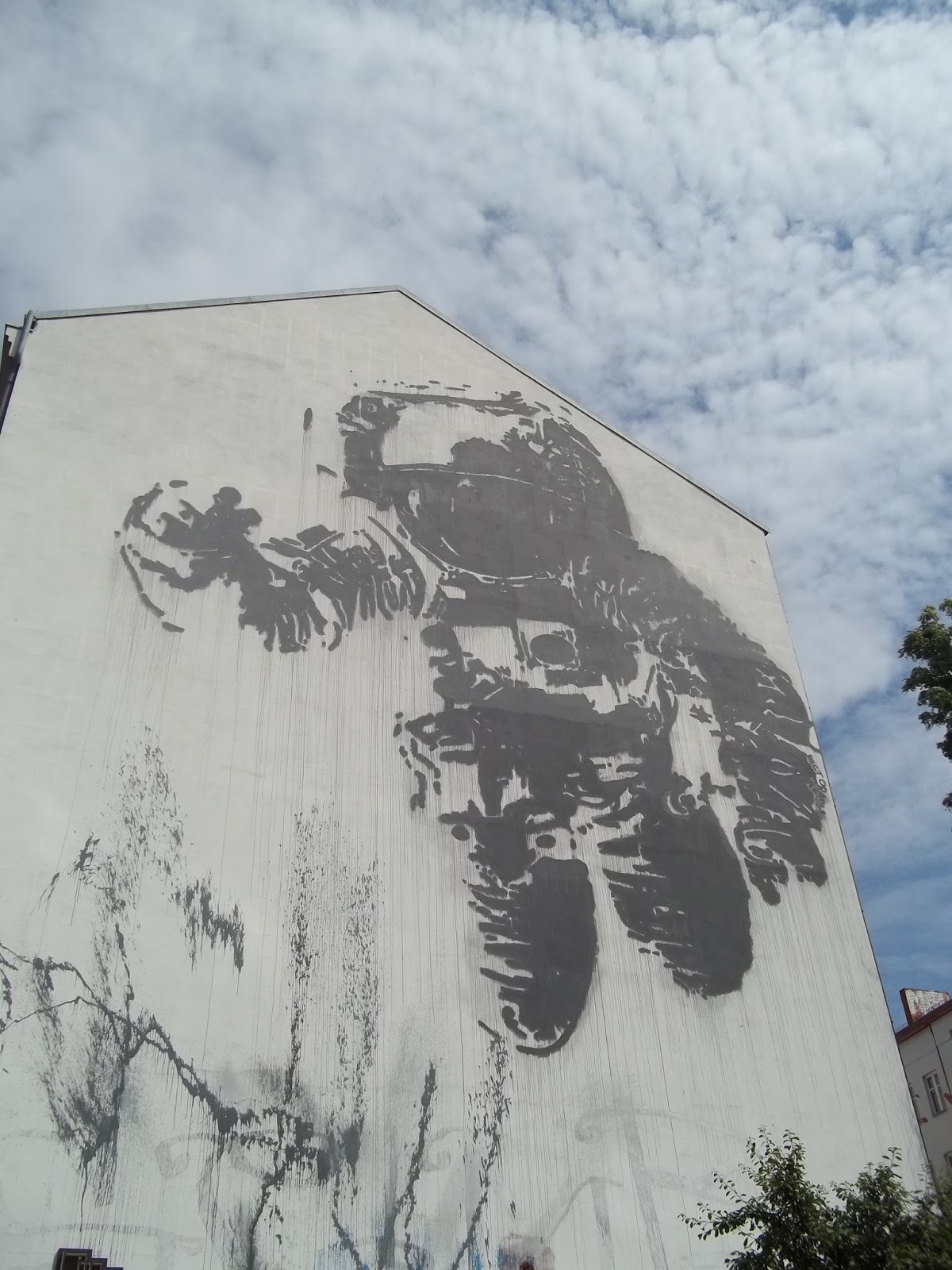
One United People 

At night, a nearby light casts the shadow of a flag on the astronaut's outstretched hand, as if he is holding it.


All right, that’s enough prose for one blog post. I had to use my imagination for the details of that story, so if anyone from the 1up crew of Berlin is an ardent follower of my blog, I’m sorry for any misrepresentation or mistakes. Think of it as promotion rather than libel!

In case you’re wondering, the 1up crew of Berlin is a real group that does things such as paint trams with military precision. I bring them to your attention because I think they embody certain characteristics that are essential to the spirit of Berlin. Because of this spirit, Berlin is recognizably different from any other city I’ve visited. It’s got kind of a punk feel to it. It’s not necessarily a beautiful city, but it is modern, and full of excitement. You only need to look at its past to understand why. Berlin was largely destroyed during World War II, and mostly rebuilt recently. While Berlin was still cut in half, young citizens were given exemptions from military service if they lived in Western Berlin, a small island of democracy surrounded by Eastern Germany that would be otherwise unappealing. The city filled with college-age kids who left a legacy. Then when the wall came down in the recent past, others flocked into Western Berlin, leaving hundreds of residences in East Berlin open without any kind of market. Squatters and starving artists moved into these residences and gave the area an edgy, alternative kind of feel that it still has today. Even now, it’s constantly changing and growing, evidenced by the hordes of cranes that seem to photo-bomb every picture with a horizon. People are beginning to discover Berlin, and it’s slowly becoming more expensive, and filling with a new kind of demographic, a transition that the current residents are fighting. Maybe Rome could see evidence of its past through the building that had survived for thousands of years, but Berlin’s history is happening now, this instant. You only need to look at the differences in the colors of the light bulbs between Eastern and Western Berlin (for this reason the divide is still visible from space) or at the raging battles in this city right now.
            
By the way, I took most of the photos of graffiti on an “alternative tour” of Berlin, in which I also learned much of this history lesson. Did you know that within one night, a wall like the one in the picture above (minus the artwork) was constructed around West Berlin? One night! These people went to bed like it was any other night, and when they woke up the next morning the entire city was behind a twelve-foot barrier.
            
Along with the wall, I made sure to visit several other sites in Berlin. I have to say that the German History Museum was the most interesting place. I could have easily spent an entire day there. Surprisingly, my American education neglected to provide me with much knowledge on German history. Of course, we all learned about these kinds of things:


But Germany’s history is not all about world wars.


Berlin is also the hometown of one of the best fast food meals that must be in existence.


This delicious food is known as currywurst. It may be a difficult concept to grasp, but the name comes from a combination of bratwurst and curry. Mind blowing, right? As a cheap college student, it made for a great meal beneath the tram tracks, especially when you could get two of these things with fries for only five euro.

As much fun as I had in Berlin (I went with Hannah and some other Americans living in Munich, so of course it was fun), I made sure to see some of the sobering sights as well. I stopped by the Holocaust Memorial, a good place for pondering. I also visited the topography of terror, a museum dedicated to the Gestapo and their tactics during WWII. Within, I found newspaper pages printed in Germany during that time period, Hitler filling the front page. I saw mug shots of holocaust victims and heard their stories. There were walls of depressing photos too.


But I'd like to end things on a better note. It's been awhile since I uploaded a blog, and that's because I've been in the Alps, where I couldn't really upload anything to the internet. So here's a preview for my next post.



Monday, August 5, 2013

Travelling around the City of Porteños

This weekend, I had the opportunity to see the diverse aspects of Buenos Aires. Since the city was built around a port, it is sometimes called Porteña City. As such, the citizens of Buenos Aires are often referred to as Porteños.

My host P.I. invited me to her home to meet her husband and to see some sights in the city. After a short bus ride, I found myself in the downtown area of Buenos Aires. My P.I.'s flat is absolutely gorgeous and has a European-esque interior architecture. Her study was well designed and had some interesting artwork:


Animal figureheads used by indigenous people in Northern Argentina for special ceremonies.
Afterwards, we walked around the neighborhood to look at some points of interest. One of them included the great ombú tree.

ombú
It's branching was extraordinarily long and extensive. It was hard to believe that it all came from one tree. This majestic tree is regarded as something like the unofficial national tree of Argentina. Apparently the branches grow so large sometimes that they have to be held by scaffolds to support the massive weight. A park was built around the great ombú, and families were out enjoying the warm Sunday afternoon. Buenos Aires has several such parks dotted around the city, and they work as nice respites from the towering skyscrapers and bustling city life.

The Obelisk of Buenos Aires
Only a few hundred meters away from the ombú tree, one can see the massive Obelisk monument. This is one of the great symbols of the city and are comparable to the Empire State Building of New York City or the Space Needle of Seattle. It stands proudly at the center of a busy intersection that is supposedly the widest avenue in the world.

María Eva Duarte de Perón
On the same avenue lies a building that commemorates one of the most influential First Ladies of Argentine history. She was affectionately known as Evita Perón by the common people, and she was a champion for woman's suffrage and the well-being of the poor. She was widely popular among the people and was known as the "Spiritual Leader of the Nation" before her early death. Evita's work as a revolutionary female political activist is still celebrated by Argentinians.

The Río de la Plata
Next on the stop was the great Río de la Plata. Literally, the name translates to the Silver River. This acts as the water boundary between Argentina and Uruguay. However, the river is so vast, you couldn't make out the other side. I actually thought it was an ocean because it was so expansive. One could say that the port based off of this river is what gave Buenos Aires its namesake.

Bife de chorizo (top); papas fritas provenzal (left); house-baked bread and chimichurri sauce (right)
We went to one of the most popular tourist destinations of Buenos Aires for carne asada in the colorful neighborhood of San Telmo. The name of the restaurant was El Desnivel, and it is definitely worth the trip, even if some wait time is involved. I ordered a dish of bife de chorizo, which is like a type of sirloin cut. It is rated by many websites to be the #1 cut of meat to try in Buenos Aires. Chimichurri sauce, which is an olive oil-based sauce with many different spices, works as a very good steak sauce. To accompany my main course, I ordered papas fritas provenzal (very crispy French fries with parsley and garlic). The meal was definitely satisfying and left me full for the entire day.

A remodeled house in San Telmo, now transformed to various artisan shops.
San Telmo is definitely one of the tourist hot-spots in Buenos Aires. On the streets, there are artisans with their craftsmanship displayed and for sale. Food vendors regularly walk around with empanadas, cakes, and other sweets, hoping to catch the attention of passerby. Many of the buildings used to be residences of wealthy families, but after years of disuse, they have been renovated into shops.


Inside the shops, many artisans are actively at work, making all kinds of hand-woven clothes from the native llama wool. These are definitely beautiful pieces but very pricey for their authenticity and quality of work.

Plaza Francia on a beautiful Sunday afternoon.
Our last stop was at Plaza Francia, definitely a recommended destination for visitors to the city. There were many people simply lounging on the grass on picnic blankets while various musicians performed impromptu concerts in front of them. But the real attraction of Plaza Francia lies in the various stalls lined up around the grassy areas. All kinds of artisans flock to sell their creations on Saturdays and Sundays. These goods go from mate tea gourds, to Argentinian leather bags, to handcrafted silver jewelry, and many more.

In terms of my research, things have progressed better than we hoped for! Although we don't have a substantial n for the second round of experiments, correlations have been unbelievably high (~0.98 range). My P.I. would like for me to start up another write-up of our results, so most of this week will be dedicated to that cause. We may also start a third group of experiments which will measure the activity of the two cells that we previously studied in relation to tension application. That will work as a nice wrap-up to everything I've done here so far! With a little less than three weeks left here, I'm hoping to make the most out of my time in Buenos Aires.

Saturday, August 3, 2013

Special

As a lot of Germans will admit, Bavaria is a "special" place.  I don't think any other place in Germany has preserved its traditional culture as well as Bavaria.  In fact, when most people around the world think of German culture, they're referring to the beer drinking culture of Bavaria.  And when you walk around Bavarian towns and see people dressed in traditional garb, carrying around massive beer steins, and having a jolly good time in the beer gardens, you realize that even today, Bavaria is still very much connected to its roots.

Perhaps because of such a rich culture that is still very much alive, Bavaria has a fierce sense of pride and independence.  As many people here say, you have Germany.  And then, you have Bavaria.  It's truly the Texas of Germany.  In fact, the official name of Bavaria is the "Free State of Bavaria".  There's even a Bavarian political party with the slogan (roughly translated) "Because we can do it ourselves".  Although Bavaria is, of course, not a free state, there is the sense that Bavarians are different from the rest of Germany.  Munich, in the heart of Bavaria, embodies this culture, pride, and independence.

When I visited Berlin last weekend, I realized there's no place more different from Munich than Berlin.  Berlin is a place of incredible history and mixing of people, cultures, and ideas.  People from Munich say Berlin is "dirty and creepy and icky", but in truth, Berlin is not dirtier than any other major city I've seen before.  Instead, what you have is an incredible alternative atmosphere that's very cool and very hip.  You have art all over the city in the forms of graffiti and street art, and the city never sleeps.  In fact, in many parts of the city, the streets are busier at 4am than at 4pm.  It's clear people there don't care what you think about them and their city.  They love it all the same.

There's a perpetually ongoing discussion in my lab about which city is better:  Berlin or Munich.  I find it impossibly difficult to answer such a question.  The cities are so different that they feel near incomparable.  They represent two very different sides of Germany, each with its own charm.  I'm just glad I've been able to brush the surface of both sides of Germany.

Cool art from Berlin below.  These are on the Berlin Wall, but the real masterpieces are scattered all around the city!


Friday, August 2, 2013

Total Frenchification.

Paris and CERN. Within 10 days of each other. I think I might've died and went to French-y heaven. They even speak French in Geneva! Who knew?

Having wanted to study astronomy/astrophysics before I came to Emory, seeing the Large Hadron Collider (LHC) was definitely something I could check off my bucketlist. I was invited by my friend from high school who is in the DAAD program to join her and a group of other RISE scholars on a tour of CERN. In fact, they only give tours to groups, but it's 100% free! (all that much better b/c Switzerland is THE most expensive place. ever. To give you a sense of exactly how crazy pricey things are over there, a tall Starbucks frappucino over there costs more than 7 Swiss Francs, which is about $7.50. Home sweet America.)
Compact Muon Solenoid (CMS) - small but importnat part of the LHC at CERN.

The water in Geneva is so clear that you can see the swans' feet when they swim!
 Fun fact: The Evian spring is located in the mountains not far from Geneva. My PI's told me on our hike through the Alps that visitors are allowed to bring their own bottles and fill up with Evian water at the springs!
Kelly, me, Ximin, and Peyton in front of the huge fountain in the center of Geneva.
________________________________________________________________

I knew I wouldn't be able leave France without seeing beautiful Paris, so two weekends ago, I hopped on a TGV (high speed train) and found myself in the heart of this beautiful city. I even got to stay in a hostel next to the Louvre. (Louvre Youth Hostel, highly recommend it!)

Talented Parisian street musician.
Who knew being in the front row of rock concerts would prepare me for this?

Panoramic view of the Louvre on our last day in Paris.
Not to be cliché, but my favorite place in Paris has got to be the Eiffel Tower. Perhaps it's the sense of wonder at what scientists can really accomplish so ahead of their time (did you know that the Tour Eiffel was built by engineers who actually worked up there? or that cosmic radiation was discovered there?). Or maybe it's the wonderful sense of accomplishment of scaling 700 mighty steps to the 2ème étage (it's too bad they don't let you climb all the way up though). In the least, the Champ de Mars makes the perfect Frenchy photo op, no instagram-ing needed.
Paris je t'aime!
But alas, how could I go to Paris without trying macaroons at LaDurée? Of course, they make dozens of other kinds of pâtisseries, but it was impossible to take another bite after trying 8 different flavors of macaroons!
Pistachio (far right) was my favorite.
This one's for Dr. Roesch! I need someone to try them with next time I go =)
I could spend days telling you about our adventures in Paris, but the best way would just be to ask me when I come back to the states in 3 weeks! From cheese-tasting to the gardens of Versailles, Paris is easily my favorite place in Europe so far. And I'm not just saying that b/c I'm in France right now.

It was so hard to bid adieu, but I will actually be transferring trains in Paris on my way to the ferry port to England tomorrow so stay tuned!

sunrise to sunset

This past week has been quite a busy week for me. I was in my room for a great majority of the time, writing a lab report on all our findings in the first 6 weeks of my experiments. For the most part, we believe that we have reached all the conclusions we can address for now. My time this week was something reminiscent of finals week, except without any deadlines other than the ones I imposed on myself to get the paper done. It really is a different kind of experience when the greatest kind of ultimatum is yourself in getting something done!

Other than a few trips to the nearest grocery store, I did not step outside my apartment much this week. One thing that kept me going was, of course, the food. I think the greatest highlight of my week was finally getting to try Argentina's famous "carne asada." It is literally translated as grilled meat, but in Argentina it is a dry-roasted beef, marinated in special salts.

carne asada tapas; rice and chicken with a tomato-based sauce; fish-fillet, ham, and spinach rolled up california roll-style (I forgot the actual name)
Argentina, which is known for the beef its constituents produce and consume in great quantities, certainly has perfected the way to cook a truly fine piece of meat. The beef was succulent and juicy while the outer skin was deliciously crispy. My sides were great compliments to the meat's bold flavor and brought me extreme satisfaction. Now I honestly say that I've had the authentic Argentinian culinary experience. 


On other nights, I ate less marvelous dishes; however, would you believe that this pizza came from the freezer? It was definitely better than any frozen pizzas I've had in the U.S. Strangely, there was no tomato sauce to be found, but the strange mix of cheese and onions added an almost creamy-quality to the pizza, pardoning the absence of former. My roommate, who seems to be a very talented cook, actually grows basil in the apartment, and when she saw my pizza in the oven, she offered me some basil leaves to go along with the dish. I would say that the shredded basil on top really brought the dish together.

One of my most favorite sights: my dissection tools laid out neatly before me.
After finishing the first draft of my report, I was able to get back to the experimenting bench on our new project. This time we will be investigating the responsiveness of T(touch)-cells in the leech ganglion and their responsiveness to tension application. It's not very different from the set of experiments I just completed, but now we will work with an entirely different cell with new properties to ascertain. I can honestly say that basic research brings this type of thrill for me.

ensaïmada, a traditional rarity
My host P.I., who went on a small weekend trip to the nearby town of San Pedro, brought this delectable pastry dish for her busy worker bees in the lab. It is a pastry made only by recipes passed down by long traditions. It reminds me of a very large, puffy cinnamon bun (without the cinnamon). It is a rather light pastry, and after some research, I believe the secret ingredient is reduced pork lard. There was a custard-like filling that blended in with the light texture of the pastry and glazed with powdered sugar on top.

The origins of this pastry come from Majorca, the largest of the Balearic Islands in Spain. A group of people from the island community immigrated to San Pedro and brought their recipes with them long ago. Apparently, it is the type of traditional cuisine that does not have an exact recipe. So really, the only places where one could taste this authentic cultural gem would be in Majorca, San Pedro, or any of the handful of places in the world inhabited by Majorcan descendants. I'm glad I was able to sample some of this delight!


This past week was definitely more tiring than the rest thus far because of the paper, but I was able to enjoy some great sunsets and sunrises. I developed a kind of sleep cycle that depended on the progress of my report, so I was able to see multiple such occasions throughout the week. And since my room gives such a great view of the city, I was able to take some nice pictures.


Here's to another great week of new discoveries!!